
How Developing a Self-Care Wellbeing Toolkit Supports Emotional Intelligence in Children

Education can be a powerful tool in aiding healing and growth for children who have faced adverse childhood experiences, often abbreviated as ACEs.
These troubling experiences range from abuse to family issues and can deeply impact a child's emotional and psychological health.

This blog delves into how schools, through early intervention programmes like RISE Up combined with psychologically safe environments and trusted relationships with emotionally available adults, not only provide academic learning but also vital settings where children can develop emotional intelligence and begin their healing journey, especially through the use of a self-care toolbox.

The Importance of Early Intervention
The RISE Up early intervention mental wellbeing programme is pivotal in transforming educational environments into spaces where healing from ACEs can begin.
By training educators to recognise and respond to the signs of emotional distress, RISE Up enables prompt and effective action.
This intervention is critical as it helps mitigate the potential long-term psychological impacts of trauma.

Building a Self-Care Toolbox
A key feature of the RISE Up programme is the self-care toolbox. A set of strategies and practices designed to reduce anxiety, boost confidence, and support emotional intelligence.

The toolbox covers:
Self-Awareness through Body Scanning and Journaling: Encouraging children to become aware of their physical sensations and emotions. Regular journaling helps students understand and express their thoughts and feelings, building self-awareness and emotional literacy.
Using Physical Activity to Self-Regulate and Find Belonging: Teaching young people to understand different categories of exercise, and identify what activities they can do when they feel dysregulated or want to foster a sense of belonging. This helps them connect with their bodies and manage their emotions.
Building Self-Confidence and Self-Kindness: Exercises and affirmations aimed at boosting self-esteem and encouraging a compassionate view of oneself. The toolbox helps students recognise their achievements and approach challenges with a growth mindset.
Turning Worries into Positives to Reduce Anxiety: Using cognitive strategies to reframe worries as opportunities for growth. This helps reduce anxiety by focusing on what can be controlled and letting go of what cannot.
Developing a Sense of Purpose: Encouraging students to set personal goals and find meaning in their actions, which fosters motivation and resilience.
Promoting Healthy Habits: A focus on sleep, exercise, nutrition, hydration, and balanced social media use to support overall wellbeing.
Accessing the Four Happiness Chemicals through a Self-Care Menu: Providing students with a variety of activities that release dopamine, oxytocin, serotonin, and endorphins, enhancing their mood and mental health.
These strategies give children practical tools to manage their emotions, build resilience, and support the development of emotional intelligence.
Integrating Physical Activity with the RISE™ Framework
We empower educators to seamlessly weave physical activity into their curriculum, helping students develop a self-care toolbox that supports emotional intelligence and mental wellbeing.
To make this approach accessible and memorable, we created the RISE™ acronym; Repeaters, Inclusive Teams, Stress Busters, and Energisers.
This teaches young people how movement can be a key tool for managing emotions and improving mental health, both now and in their future lives.

Repeaters: Repetitive activities like running, walking, or yoga encourage self-awareness and emotional regulation. As part of a self-care toolbox, these activities calm the mind, reduce stress, and help students manage their emotions.
Repeaters regulate the amygdala, widen the window of tolerance, and help access the prefrontal cortex, equipping students to think clearly, make decisions, and learn effectively.
Inclusive Teams: Participation in team sports builds social skills, confidence, and a sense of belonging, key elements of emotional intelligence. The shared experience of working towards a common goal fosters oxytocin release, promoting trust and connection.
Trauma-informed practices ensure these teams are inclusive and supportive, making students feel psychologically safe as they build their self-care toolbox.
Stress Busters: Amidst the challenges young people face, many struggle to manage stress and anxiety. Stress-busting activities like boxing, weight training, and yoga offer powerful tools to safely release pent-up tension.
Incorporating these activities into a self-care toolbox helps students become more self-aware of their stress levels and develop constructive ways to balance their emotions and reconnect with their bodies.
Energisers: High-energy activities like circuit training or dance serve as tools to boost mood and motivation. By integrating these energisers into a self-care toolbox, students learn how to lift themselves up when they feel low, accessing neurotransmitters like dopamine and serotonin that support happiness and drive. This understanding of how to boost their energy positively contributes to their emotional resilience.
The RISE™ framework supports the development of emotional intelligence by helping students build a personalised self-care toolbox that they can draw upon when facing emotional challenges.
This approach not only meets statutory requirements to teach the link between physical activity and mental health but also provides young people with lifelong strategies to enhance their emotional wellbeing and resilience.
Psychological Safety in Schools
Psychologically safe educational environments are essential for fostering emotional intelligence, particularly in children affected by ACEs.
These environments promote a sense of security and belonging, allowing students to express themselves and engage with their education without fear.
Such safety is crucial as it underpins the effectiveness of the self-care toolbox, providing a stable foundation for emotional growth and learning.
Equipping Educators with Resources and Training
Our courses are designed by teachers, for teachers, providing concise, practical training and editable resources to save you precious time.
Through our RISE Up early intervention mental wellbeing and Trauma Informed PE training, educators are empowered to equip young people with the skills and knowledge to build their self-care toolbox and boost their emotional intelligence.
The courses focus on real-world strategies to integrate physical activity, self-awareness practices, and supportive mental health approaches directly into the school setting, ensuring that you can confidently foster a culture of wellbeing that extends beyond the classroom.
Case Studies: Real-Life Transformations
Bure Park Specialist Academy Case Study: The academy uses physical activity as a cornerstone of emotional wellbeing, particularly effective in engaging boys with complex needs. Emphasising the connection between physical activity and mental wellbeing has significantly improved behavioural engagement and reduced the need for physical interventions.

Charles Darwin Primary Case Study: This school has harnessed the RISE Up programme to significantly enhance pupil wellbeing through physical activity, demonstrating considerable improvements in behavioural assessments and engagement, facilitated by a supportive school environment that reduces anxiety related to school routines like changing for PE.

King’s Leadership Academy Liverpool Case Study: Here, the RISE Up programme has transformed the PE experience for disengaged Year 8 girls by focusing on inclusive activities and mental wellbeing, markedly improving their attitudes towards PE and deepening their understanding of mental health.

Supporting children with ACEs through education is complex yet profoundly impactful.
The RISE Up programme, through its emphasis on developing a self-care toolbox, equips educators with the tools necessary to transform schools into nurturing environments that support both emotional and academic development.
By integrating self-care practices with physical activity, the programme addresses immediate emotional needs and builds long-term resilience, empowering children to thrive.
A Partnership Built Around Your Context
No two settings are the same, which is why RISE Up can now be implemented in more than 17 different ways.
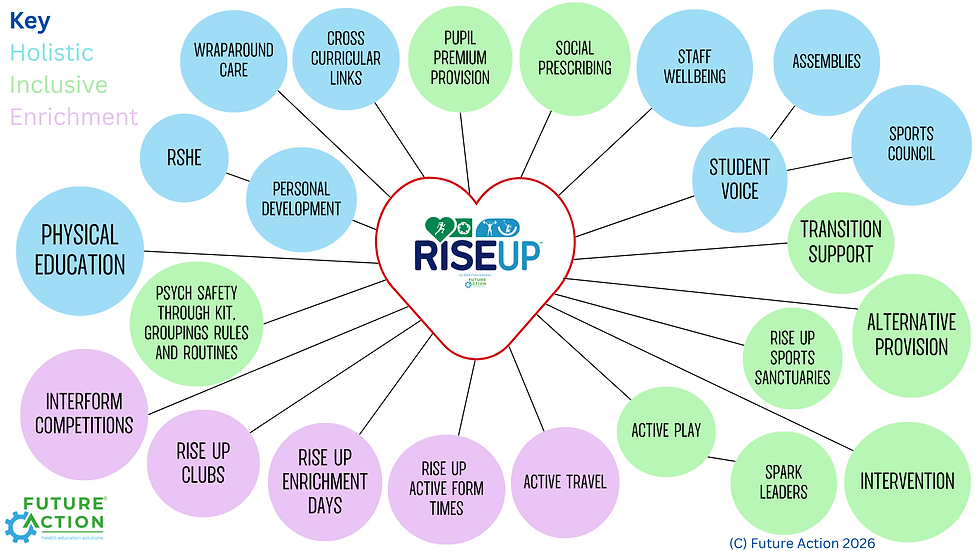
Today, RISE Up is supporting organisations across a wide range of contexts, including mainstream primary and secondary schools, special schools, alternative provision settings, Virtual Schools, wraparound care providers and regional partnerships.
From RISE Up Sport Sanctuaries and active form-time programmes to whole-school CPD, SPARK Leaders, targeted interventions, alternative provision pathways and wellbeing-focused wraparound care, settings choose the approaches that make the most sense for their young people, staff and community.
Our role is to help design the combination that is most likely to create meaningful and lasting impact.
Every RISE Up Partnership is bespoke.
What A RISE Up Partnership Could Look Like In Your Setting
Every RISE Up Partnership follows the same three-stage framework.
The structure remains consistent, but the implementation is always bespoke.
Intent
• Co-create a strategic wellbeing vision aligned to your context
• Develop a clear 90-day implementation plan to give you clarity and save you time
• Establish a baseline using the RISE Wellbeing Intelligence Snapshot
• Align the work with existing priorities, provision and funding opportunities

Implementation
• In-person and online CPD combining Trauma Informed PE, RISE Up Wellbeing, Trauma Informed Frontline Educator and Staff RISE Up training.
• Practical strategies for regulation, belonging and inclusion
• Ongoing support, coaching and implementation check-ins
• Access to RISE AI
• Unlimited staff access to our award-winning online training courses
• Editable resources and planning tools
• RISE Up Wellbeing Journals
• Access to local and national communities of practice
Impact
• Repeat the RISE Wellbeing Intelligence Snapshot
• Measure changes in wellbeing and life satisfaction
• Co-create a case study to celebrate and evidence impact
• Generate evidence for governors, stakeholders, Ofsted and funders
• Contribute to wider regional impact reporting
The most effective wellbeing strategies are never handed to schools. They are built alongside them in partnership.
Your Next Step
Step 1: Join the Waiting List
Explore partnerships, consultancy, training, speaking opportunities, or request your copy of Time to RISE Up – Supporting Students' Mental Health in Schools.

Three minutes to map your current provision and identify the greatest opportunities for impact.

Thank You
Thank you for everything you do for your young people. Have a brilliant half term ahead.
Neil Moggan and the Future Action Team
💛🤝🧠💪



Understanding the tally counter maximum count is important before starting any large counting project. Different counters may have different limits depending on their design. I think knowing these details beforehand helps users choose the right option. Preparation often leads to a smoother experience.
A meaningful texto para cerimonial de aniversário de 70 anos can make a milestone birthday celebration even more memorable. The right words help honor a lifetime of experiences, achievements, and cherished relationships. I enjoy reading heartfelt messages that reflect gratitude and admiration. A thoughtful speech can leave a lasting impact.
The question can your body do cell repair without fasting is fascinating for anyone interested in how the body functions naturally. Understanding the body's maintenance and recovery processes can provide valuable health insights. I enjoy educational articles that explain scientific concepts in simple language. Clear explanations make complex topics easier to understand.