
Planning Your 2026/27 Wellbeing Strategy? Here's What We're Seeing Across 300+ Schools

As schools begin planning for 2026/27, many leaders are asking similar questions:
How do we improve belonging?
How do we support wellbeing without creating another initiative?
How do we demonstrate impact?
How do we build something sustainable?
During the half-term break, we were delighted to learn that Future Action has been named the UK's Leading Student Wellbeing Teacher Training Course at the UK Enterprise Awards for the second consecutive year.
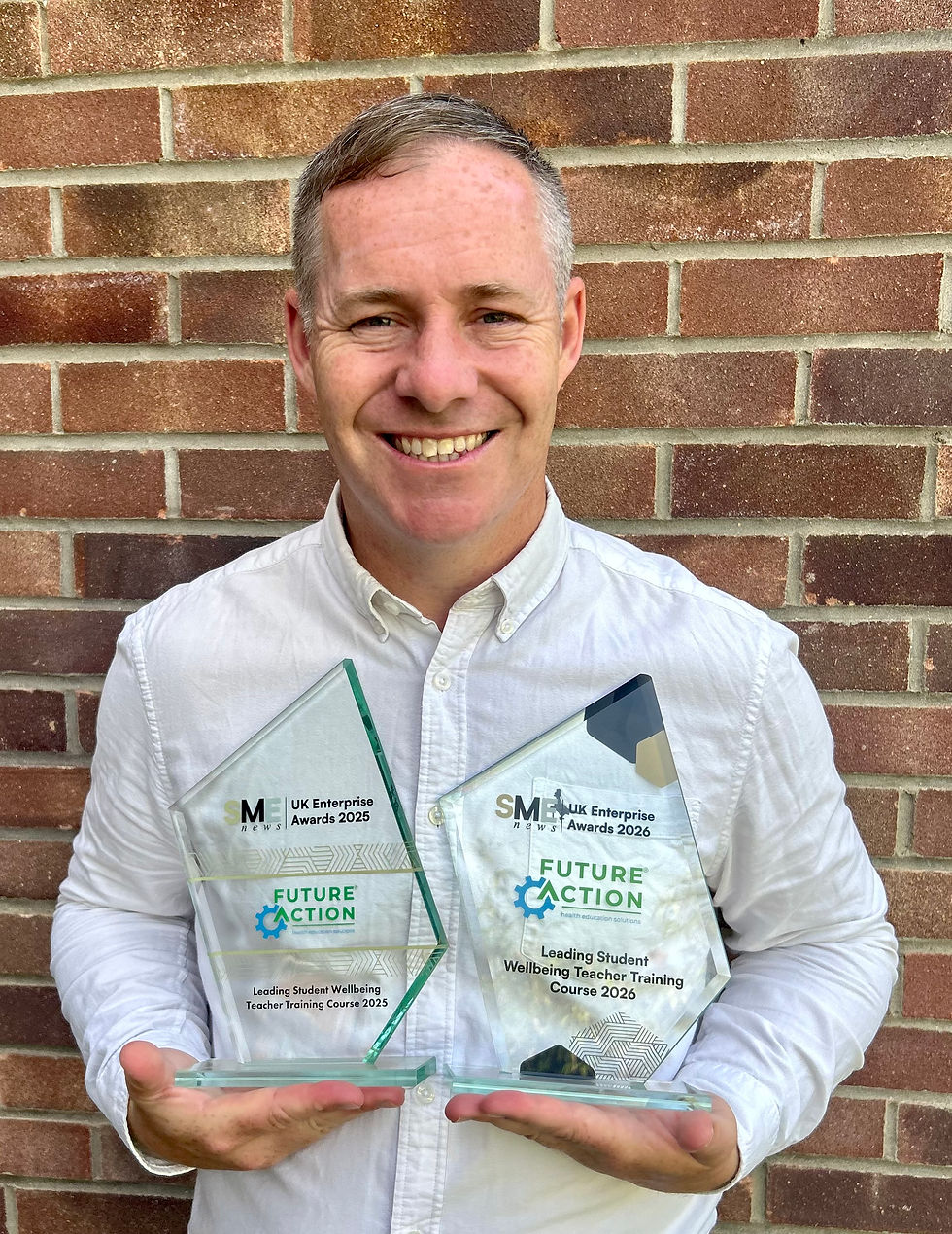
Whilst we are incredibly proud of the recognition, what excites us most is the momentum building across the country and the growing number of schools, trusts and system leaders choosing to invest in long-term wellbeing strategies for their young people.
Just before half term, we had the privilege of welcoming five innovative schools into Phase 1 of the Kent RISE Up Partnership in collaboration with Kent Virtual School.
We are also excited to launch Phase 1 of the Hampshire RISE Up Partnership this half
term, welcoming five more schools in collaboration with Hampshire Virtual School.
Together, these partnerships represent much more than a training programme. They are part of a growing movement to help schools create bespoke wellbeing strategies built around relationships, movement and self-care toolkits.
Over the last six years we have learned that the schools making the greatest progress rarely start with a wellbeing programme. They start by creating the conditions for young people to feel safe, connected and valued.
Since 2020, we have:
• Partnered with more than 300 schools across five continents
• Published over 45 case studies showcasing impact across primary, secondary, specialist and alternative provision settings
• Developed regional RISE Up Partnerships across Norfolk, Liverpool, Surrey, Devon, Manchester, Kent, Hampshire and the Wirral
• Been recognised as the UK's Leading Student Wellbeing Teacher Training Course in both 2025 and 2026
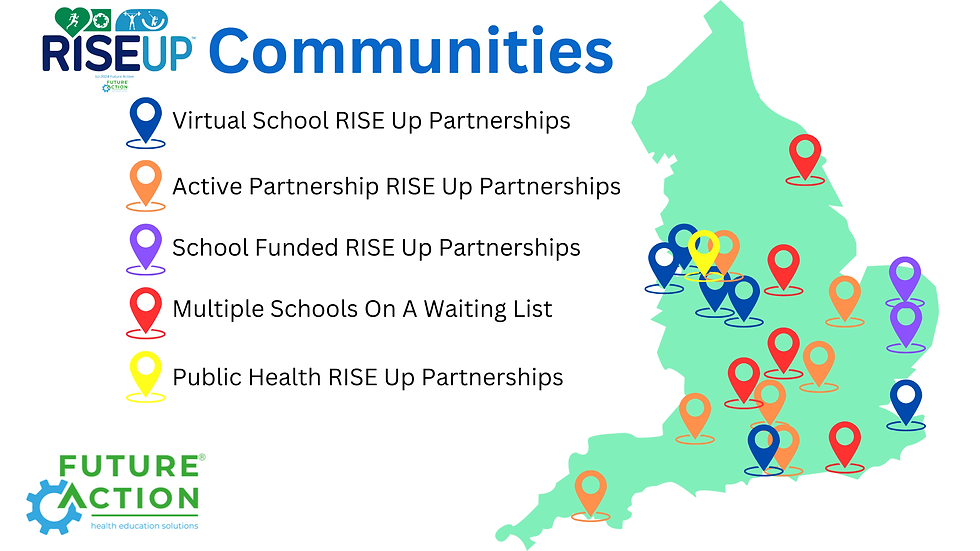
Whilst we are proud of these milestones, awards and numbers have never been the reason we do this work.
What matters most is the impact being created in schools and communities across the country.
The most exciting thing about this award is not what it says about the last six years, but what it suggests about the future and the growing appetite for approaches that place relationships, movement and self-care at the heart of wellbeing.
From Training Provider To Wellbeing Partner
Over the last six years, Future Action has evolved from delivering teacher training into becoming a long-term wellbeing partner for schools, trusts, councils and system leaders.
Every school serves a different community, faces different challenges and builds on different strengths. What works brilliantly in one setting may need adapting in another, which is why we have never believed in a one-size-fits-all approach.
Every RISE Up Partnership begins by understanding the local context before co-creating a bespoke wellbeing strategy that moves from Intent, to Implementation, to Impact.
Rather than arriving with a pre-packaged solution, we begin by listening. We work with schools, not to schools, helping them design an approach that reflects the needs of their young people, staff and wider community.
The result is not another initiative competing for attention. It is a sustainable approach that becomes part of the culture of the organisation.
The System Is Finally Catching Up
Recent developments suggest that wellbeing, inclusion and belonging are moving closer to the centre of educational thinking than at any point in the last decade.
The publication of the Game On Report, the Curriculum and Assessment Review, Ofsted's growing focus on inclusion and belonging, and the government's recent £1 billion investment in PE and school sport all point towards a more strategic approach to supporting young people.
Particularly significant is the announcement of a new PE and School Sport Partnerships Network, designed to move beyond a one-size-fits-all approach and provide both universal and targeted support based on local need.

For those of us working in this space, many of the themes feel familiar: belonging, wellbeing, inclusion, partnership working, tackling inequalities and building local capacity.
For the first time in many years, national policy appears to be moving in a direction that reflects what many educators and system leaders have been saying for a long time.
The challenge, however, remains the same. There is often a significant gap between what reports recommend and what actually happens in a classroom, playground or PE lesson on a wet Tuesday afternoon in February.
At Future Action, we have been helping schools bridge that gap since 2020.
We did not build RISE Up because a report told us to. We built it because we experienced first-hand the challenges facing young people and the limitations of waiting for problems to escalate before support is provided.
In many ways, policy is now beginning to ask for what schools have needed all along.
The organisations partnering with us today are not simply responding to change. They are helping shape it.
What Happens When a Region Commits
Perhaps the clearest example of what a RISE Up Partnership can achieve at scale is Norfolk.
Over a three-year period, we worked alongside Norfolk County Council to support more than 150 schools across the county. That investment built enough confidence, belief and capacity that many schools now choose to continue their wellbeing journey independently.
That is what sustainable, school-owned change looks like.

"It is exciting for us to have a programme developed by a teacher for teachers. RISE Up has a really clear emerging and emerged evidence base.
We have had fantastic buy-in at secondary level which has enabled us to build a community of like-minded colleagues who can transform the mental wellbeing of our young people over the coming years.
Norfolk County Council is moving towards a consistency of approach across settings so programmes like these are really important."
Josie Rayner-Wells
Senior Adviser for Inclusion, Early Intervention and Prevention
Norfolk County Council
More than 150 schools engaged with the Norfolk RISE Up Partnership over a three-year period. Perhaps most encouragingly, many schools have continued the journey independently, creating a growing community of practitioners who continue to share ideas and support one another.
For us, that is the real measure of success. The model has demonstrated that, with the right support and local leadership, sustainable change can be achieved at scale.
New Ways We Can Support Your Wellbeing Strategy in 2026/27
The RISE Wellbeing Intelligence Snapshot
One of the most common challenges we hear from senior leaders is this:
"We know some of our young people are struggling, but we cannot always see clearly enough where, how much, or what to prioritise first."
The RISE Wellbeing Intelligence Snapshot has been designed to help answer that question.
Completed by young people in around five minutes, the survey draws on validated wellbeing and life satisfaction measures to provide schools with a clearer understanding of where support may be needed most.
We support schools through the ethics process with parents and staff, ensuring that young people's identities remain protected throughout.
Within 48 hours, schools receive a personalised report highlighting strengths, areas for development and recommendations for next steps.
Nine months later, the survey is repeated with the same group, creating a meaningful before-and-after picture of change over time.
Working alongside system partners, we are also exploring ways to calculate the wider social impact value created through wellbeing interventions.
The result is a source of real-time intelligence that is gathered ethically, turned around quickly and designed to help schools make informed decisions with greater confidence.
RISE Up Wellbeing Journals in Partnership with GCSE Simplified
If you know GCSE Simplified, you will know what Tony Corcoran has built.

His handwritten, hand-drawn revision guides are loved by young people and teachers across the country for making complex content feel warm, accessible and engaging.
Tony has brought that same distinctive style to our new RISE Up Wellbeing Journals.
Designed primarily for Key Stage 3, whilst also being highly effective with Years 5 and 6, the journals combine reflective prompts, self-care strategies, activities and journalling space.
They sit at the heart of the self-care toolkit element of the RISE Up approach, giving young people a practical resource they can return to again and again.
The journals are included within our partnership packages and will also be available separately for schools wishing to use them independently.
What A RISE Up Partnership Could Look Like In Your Setting
Every RISE Up Partnership follows the same three-stage framework.
The structure remains consistent, but the implementation is always bespoke.
Intent
• Co-create a strategic wellbeing vision aligned to your context
• Develop a clear 90-day implementation plan to give you clarity and save you time
• Establish a baseline using the RISE Wellbeing Intelligence Snapshot
• Align the work with existing priorities, provision and funding opportunities

Implementation
• In-person and online CPD
• Practical strategies for regulation, belonging and inclusion
• Ongoing support, coaching and implementation check-ins
• Access to RISE AI
• Unlimited staff access to our award-winning online training courses
• Editable resources and planning tools
• RISE Up Wellbeing Journals
• Access to local and national communities of practice
Impact
• Repeat the RISE Wellbeing Intelligence Snapshot
• Measure changes in wellbeing and life satisfaction
• Co-create a case study to celebrate and evidence impact
• Generate evidence for governors, stakeholders, Ofsted and funders
• Contribute to wider regional impact reporting
The most effective wellbeing strategies are never handed to schools. They are built alongside them in partnership.
A Growing Evidence Base
One of the greatest strengths of the RISE Up community is its willingness to share learning.
Every partnership teaches us something new. Every school adapts the approach to fit its own context. Every case study adds another piece to the puzzle.
Today, our website hosts more than 45 case studies from schools, trusts and system partners across the UK.

The evidence emerging from many of these partnerships is becoming increasingly strong, with schools reporting improvements in engagement, attendance, wellbeing, belonging and behaviour.
At the same time, we have a growing number of additional case studies currently at draft stage that will be shared with the RISE Up community over the coming months.
Together, they are helping to create a powerful practitioner-led evidence base for what happens when relationships, movement and self-care toolkits are placed at the heart of school improvement.
The story is still being written, but the evidence is becoming increasingly difficult to ignore.
A Partnership Built Around Your Context
No two settings are the same, which is why RISE Up can now be implemented in more than 17 different ways.
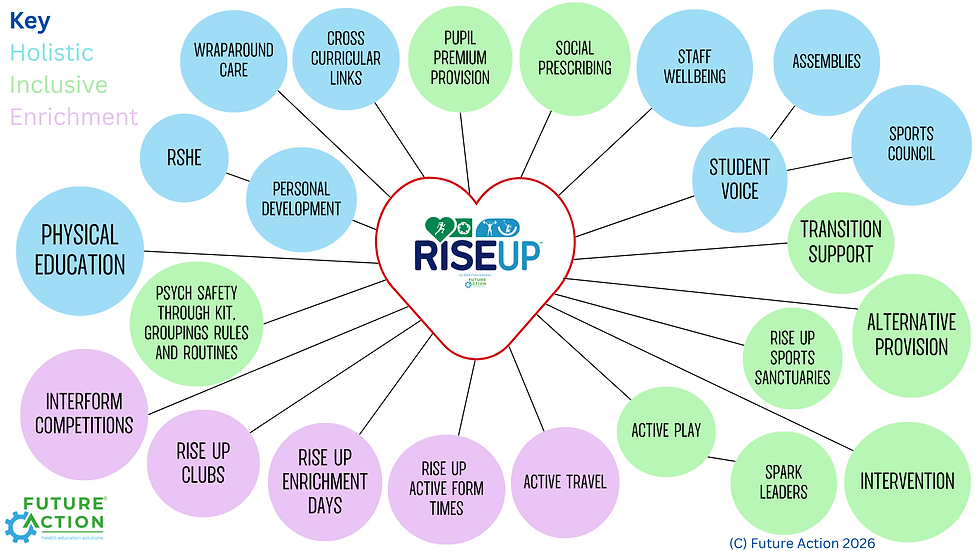
Whilst the partnership was originally developed within schools, over the last 12 months we have increasingly worked alongside colleagues in alternative provision, specialist settings and wraparound care programmes, helping them adapt the principles to meet the needs of their own communities.
Today, RISE Up is supporting organisations across a wide range of contexts, including mainstream primary and secondary schools, special schools, alternative provision settings, Virtual Schools, wraparound care providers and regional partnerships.
From RISE Up Sport Sanctuaries and active form-time programmes to whole-school CPD, SPARK Leaders, targeted interventions, alternative provision pathways and wellbeing-focused wraparound care, settings choose the approaches that make the most sense for their young people, staff and community.
Our role is to help design the combination that is most likely to create meaningful and lasting impact.
Every RISE Up Partnership is bespoke.
That flexibility is one of the reasons the partnership continues to grow. Rather than asking settings to adapt themselves to fit a programme, we work alongside them to adapt the partnership to fit their context.
Sustainable Change Takes Time
Most meaningful change cannot be achieved through a single training day or short-term
intervention.
That is why many of our partnerships run over three years.
The first year focuses on creating strong foundations.
The second year deepens implementation and strengthens consistency.
The third year develops internal capacity and confidence so the work can continue long after our formal involvement ends.
Our goal is never to create dependency. It is to help schools build the confidence, capability and evidence base to sustain the work independently.
We measure success not by how dependent schools become on us, but by how confident they become without us.
The Evidence
• School Wellbeing Scorecard: 40% → 79% in six months
• Mental fitness provision: 0% → 88%
• Teacher perceptions of student wellbeing: 61% improvement on WEMWBS
• One Year 5 pupil reduced absence from 31 days to 7 days

• 39% improvement in teacher perceptions of student mental wellbeing

• 20% improvement in teacher perceptions of student mental wellbeing
• More than 150 schools reached across the county
• Physical holds reduced from 50 to 10 over two years
These are not isolated examples. They reflect what can happen when relationships come first and wellbeing is approached strategically rather than reactively.
Looking Ahead
The conversation around student wellbeing is changing. The expectations on schools are changing. The evidence base continues to grow.
The question is no longer whether relationships, movement and self-care matter.
The question is how intentionally we build them into the daily experience of young people.
The recent announcement of a £1 billion investment into PE and school sport, alongside the creation of a new PE and School Sport Partnerships Network, suggests that the next few years could represent one of the most significant opportunities in a generation to strengthen wellbeing, belonging and physical activity for young people across the country.
Against this backdrop, the schools, trusts, councils and system partners making strategic decisions today will be the ones leading the conversation over the next five years.
If you are looking for more than a training course, more than a one-off wellbeing initiative, and more than a quick fix, we would love to start a conversation.
Whether you are an individual school, a Multi-Academy Trust, a Virtual School, an Active Partnership, a Public Health team or a local authority, we would be delighted to explore what a bespoke RISE Up Partnership could look like in your context.
Your Next Step
Step 1: Join the Waiting List
Explore partnerships, consultancy, training, speaking opportunities, or request your copy of Time to RISE Up – Supporting Students' Mental Health in Schools.

Three minutes to map your current provision and identify the greatest opportunities for impact.

Step 3: Stay Connected
Subscribe to our weekly newsletter for wellbeing insights, practical strategies and case studies from schools across the country.
Thank You
Thank you for everything you do for your young people. Have a brilliant half term ahead.
Neil Moggan and the Future Action Team
💛🤝🧠💪


Accurate Ring Sizing can make all the difference when choosing a special piece of jewelry. A well-fitted ring feels comfortable and secure without being too tight or loose. I think accuracy is especially important for meaningful purchases. Accurate Ring Sizing taking time to measure properly is always worthwhile.
By understanding the resizing process, costs, limitations, and benefits, ring owners can make confident decisions and ensure their treasured oura ring subscription pieces remain comfortable, attractive, and ready for everyday wear.